
PENA PALACE ARCHITECTURE
Exploring the iconic design of Pena Palace
Pena Palace, in Sintra, Portugal, is a stunning Romantic-era landmark that combines various 19th century architectural styles, including Neo-Gothic, Neo-Manueline, Neo-Islamic, and Neo-Renaissance. Originally a Hieronymite convent belonging to the Order of St. Jerome, it was transformed in the 1840s, preserving the old structure while adding features like a clock tower, large terraces, and colorful Moorish-inspired designs.
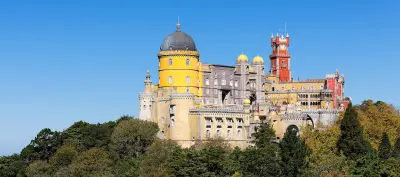
The palace’s vibrant reds, yellows, and blues contrast the green hills. Its towers, detailed windows, and ornate stonework create a fairytale-like appearance. This unique blend of styles has made Pena Palace a UNESCO World Heritage Site, one of the Seven Wonders of Portugal, and a true architectural masterpiece.

From chapel to fairytale palace
Initially built as a monastery during the Middle Ages, Pena Palace dominates the skyline on a rocky hill in the Sintra Mountains, overlooking the town of Sintra. It began as a chapel dedicated to Our Lady of Pena and later expanded into a Manueline-style monastery during King Manuel I, blending Gothic and maritime influences. The cloister had open galleries around a square patio, with round arches on the lower floor and slightly curved arches above. The walls were decorated with colorful Hispano-Mudéjar tiles made using the cuerda seca technique, which separated colors with grooves to create geometric patterns.
The monastery remained in use until the 1755 Lisbon Earthquake left it in ruins. In 1838, Prince Ferdinand II purchased the site and, working with architect Baron Wilhelm Ludwig von Eschwege and Queen Maria II, transformed it into a Romantic-style palace. The design incorporated Neo-Gothic, Neo-Manueline, Neo-Islamic, and Neo-Renaissance styles, influenced by Greek mythology and landmarks like the Belém Tower. Many elements of the original Hieronymite convent, such as the cloister, dining room, sacristy, and Manueline-Renaissance chapel, were carefully preserved and combined into the new palace design. A spacious terrace and a clock tower were added in 1843, and the final decorative work was completed by 1847.

Preserving Romantic-era architecture
After its transformation in 1838, Pena Palace continued to evolve. Minor adjustments were made while it served as a summer residence for the Portuguese royal family. In 1910, after the monarchy ended, the palace became state property and a national monument, opening to the public with updates for visitors. Over the years, its colors, tiles, and structures were restored to maintain their original appearance. In 1995, Pena Palace became a UNESCO World Heritage Site as part of the Sintra Cultural Landscape, leading to more conservation efforts. Modern upgrades included visitor facilities, pathways, lighting, and restoring original colors. Today, continuing preservation measures maintain its status as a cultural and tourist icon, celebrated for its unique architectural and historical significance.

Blending architectural styles
Pena Palace’s design blends different architectural styles, bright colors, and detailed decorations, reflecting the creativity of the Romantic era. Some architectural structures resemble medieval elements, such as parapet paths, lookout towers, an access tunnel, and a drawbridge. The palace’s design incorporates Manueline and Moorish influences, with each element contributing to its unique appearance, from its impressive entrance to its elegant interiors and scenic terraces. The palace is divided into four main sections: the exterior, the interior, the courtyards and terraces, and the surrounding park. It harmoniously combines its vibrant exterior with elegant interiors and offers panoramic views of the Sintra region. It is one of the most iconic landmarks in Portugal and one of the best examples of 19th-century Romantic revivalism in Portugal.
Ready to explore the Pena Palace?

Save time
Pena Palace and Park Skip-the-Line Ticket
Skip the line to visit Pena Palace and walk around its magnificent park! See the palace's unique architecture, enjoy stunning views of Sintra from atop the hill, and visit the Chalet of the Countess of Edla. Your ticket is valid for 1 day, giving you plenty of time to explore the UNESCO World Heritage site.

Explore at your own pace
Pena Palace Ticket with Audio Guide
Explore the vibrantly colored royal residence of King Ferdinand II and the 19th-century symbol of Portugal - Pena Palace. Every corner of this architectural masterpiece offers scenic views. It features a fusion of Gothic, Renaissance, Moorish, and Manueline styles. Take your time and navigate the castle by listening to our audio guide available in four languages.

A fusion of color and style
The exterior of Pena Palace is as beautiful as its interior, featuring a colorful and unique mix of 19th-century Romantic architecture. Elevated on a hill in Sintra, it blends bright colors with Gothic Manueline, Moorish, and Renaissance styles. Its arches, domes, and towers give it a magical, storytale-like look. The palace’s Neo-Manueline facade is painted in bold shades of red, yellow, and gray, creating a contrast against the greenery of the surrounding landscape.

The unique structure of Pena Palace
The design of Pena Palace includes several main architectural elements that define its distinctive character. The entrance gate, with its Gothic-inspired, pointed arches, intricate stone carvings, and tiled details, creates a grand entry that sets the tone for the palace. The outer walls, turrets, and towers surround the structure. Their bright yellow and red facades, crenellated walls, and cylindrical towers resemble medieval fortifications and add to the palace’s storybook castle appearance. With its square structure, prominent clock face, and ornamental battlements, the clock tower is a central visual symbol of power and time. The courtyards, decorated with paved open areas, vibrant tilework, and fountains, act as transitional spaces, connecting the interiors with the exteriors. Together, these elements highlight the palace’s imaginative and harmonious design.

Mythical decorations: The Triton Gate
The Triton Gate is a standout feature of Pena Palace, serving as a decorative centerpiece and entry point. It presents a mythological sea creature symbolizing the union of land and sea, surrounded by detailed carvings.
Panoramic views from the terraces
Several terraces provide panoramic views of Sintra, the Atlantic Ocean, and the lush surrounding forests. These panoramic viewing platforms are decorated with vibrant tiles and intricate railings. The Queen’s Terrace offers one of the best views of the palace’s architecture and includes a unique sundial cannon that once fired daily at noon.

Chapel of Our Lady of Pena
One of the key highlights of the palace is the chapel, designed by French architect Nicolau Chanterene in the early 1500s, which survived the 18th-century Lisbon earthquake largely intact. It features a beautiful alabaster altarpiece and other Neo-Gothic elements, stained glass windows, detailed woodwork, and vaulted ceilings.
Gardens and parklands
Pena Park is a vast forested area surrounding Pena Palace, covering over 200 hectares of rugged terrain. Designed by King Ferdinand II with the help of Baron von Eschwege and Baron von Kessler, the park reflects the Romantic style of the palace. It includes a wide variety of exotic trees from around the world, such as North American sequoias, Lawson’s cypress, magnolias, Chinese ginkgo, Japanese Cryptomeria, and Australian ferns. Many of those plants are prominently displayed in the Queen’s Fern Garden. Winding paths and narrow roads connect the palace to various attractions and the park’s two main gates, offering stunning views of the Sintra hills.

Inside the Pena Palace
The interiors of Pena Palace, designed as the royal family’s summer residence, present the opulence and creativity of 19th-century Romanticism.
Royal apartments: Lavishly decorated royal apartments feature ornate furniture, tapestries, and intricate detail.
The Great Hall: The Great Hall includes an impressive dining area, chandeliers, and decorative ceilings.
Walls: Stunning azulejos (decorative ceramic tiles) with Portuguese and Moorish influences add vibrant patterns to the walls, and trompe-l’œil paintings create an illusion of depth and grandeur.
The ceilings: They are decorated with exquisite stucco and fresco designs, and colorful stained glass windows highlight the elegant atmosphere.
The kitchen: The historical kitchen, preserved with traditional copper pots and tools, provides insight into 19th-century culinary practices.
Windows: Large windows and observation rooms offer beautiful views of the surrounding Sintra hills, making the interiors a harmonious blend of luxury, artistry, and history.

Windows & tiles
The windows of Pena Palace are designed in various styles, including Neo-Manueline and Gothic designs, with ornate Moorish details, lancet shapes, and colorful stained glass that brighten the interiors. The tiles, or azulejos, display intricate patterns and vibrant colors inspired by Portuguese and Moorish traditions. These decorative tiles cover the walls and courtyards of the palace, adding beauty and historical character.
Walls, courtyards & arches
The walls of Pena Palace are brightly colored in yellow and red, with decorative tiles and carved stonework reflecting Moorish and Gothic influences. The courtyards, paved with stone and decorated with tilework and fountains, offer tranquil spaces with stunning views. The arches, in Gothic, Moorish, and Renaissance styles, include intricate carvings and add to the palace’s romantic charm.
Want to learn more about the Pena Palace architecture?

Palace & park access
Pena Palace Guided Tour
Visit Pena Palace and explore its unique architecture and learn about its past from an expert guide! Hear stories about the King-Artist, Ferdinand II, who bought and built the palace. You can also go for a walk in Pena Park, whose gardens were also designed by the king.

Explore more of Portugal
Sintra, Pena, Regaleira and Cascais Tour from Lisbon
Spend a day discovering the beautiful nature, castles, and small towns of Portugal's countryside with this tour. Learn about architectural styles and visit the westernmost point of continental Europe - Cabo da Roca! This tour is available in multiple languages!