
PENA PALACE HISTORY
Pena Palace. A story through the centuries
Pena Palace’s history dates back to the 12th century when a chapel dedicated to Our Lady of Pena was built on its site. In the 16th century, King Manuel I initiated the construction of the Royal Monastery of Our Lady of Pena, which was given to the Hieronymite Order. The monastery remained active until the 1755 Lisbon earthquake caused severe damage.
In 1838, King Ferdinand II bought the ruins of the monastery and transformed them into a Romantic-style palace, blending various architectural elements to create the iconic structure seen today. After the monarchy was abolished in 1910, Pena Palace became state property and a public museum. In 1995, UNESCO recognized Pena Palace as part of the Sintra Cultural Landscape, helping to protect its historical and cultural value.

Early history: From chapel to monastery
The origins of Pena Palace date back to the 12th century, when a chapel dedicated to Our Lady of Pena was built on the site in Sintra. During the reign of King Manuel I, the Royal Monastery of Our Lady of Pena was constructed and placed under the care of the Hieronymite Order. It was designed in the Manueline style and combined various architectural styles. It featured detailed ornamentations and walls and tiles in vibrant, bold colours.
The monastery remained a peaceful retreat for centuries until the 1755 Lisbon earthquake caused major structural damage. Despite this, it remained in use until 1834, when it was left empty after the abolition of religious orders in Portugal. Some remnants from this period, like the Monk’s Grotto, can still be found within the Park of Pena.

The King-Artist’s Romantic vision for Pena Palace
In 1836, Queen Maria II married Ferdinand of Saxe-Coburg and Gotha, who became King-Consort of Portugal. Ferdinand II, known as the “King-Artist,” was a highly cultured man fluent in several languages and deeply passionate about the arts. Shortly after arriving in Portugal, Ferdinand fell in love with Sintra and, in 1838, purchased the ruined 16th-century Monastery of Saint Jerome and the surrounding lands. Originally planning to restore the monastery as a summer residence, he instead created a palace inspired by the Romantic ideals of his time.

Transformation into a Romantic masterpiece
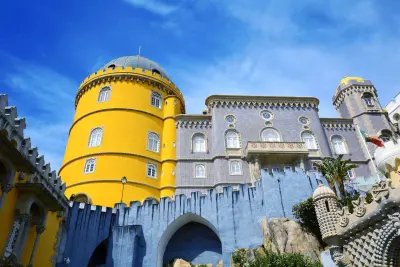
King Ferdinand II drew inspiration from Neo-Gothic, Neo-Manueline, Moorish, and Renaissance architecture and hired German architect Baron Wilhelm Ludwig von Eschwege to turn the monastery into a palace. Construction began in 1842 and was mostly finished by 1847, with final decorative details completed by 1854. Pena Palace combines different styles, reflecting the Romantic era of the 19th century. It features Gothic, Neo-Manueline, Neo-Islamic, and Neo-Renaissance elements, giving it a unique and colorful look. Towers, domes, and arched windows take inspiration from medieval castles and exotic influences. Its bright yellow and red walls add to its fairytale charm. King Ferdinand II wanted the palace to blend with the natural landscape, so it was built on a hilltop with breathtaking views of Sintra. Today, its mix of styles makes Pena Palace one of Portugal’s most recognizable landmarks.

The Park of Pena
King Ferdinand II appreciated the beautiful natural landscape around the palace and wanted to create a park, combining exotic plants with the existing scenery. Designed in the Romantic style, the park includes winding paths leading to landmarks like the High Cross, Temple of Columns, St. Catherine’s Heights, and the Valley of the Lakes. The park is known for its Asian camellia collections from the 1840s, which became part of Sintra’s winter festivals. It also includes pavilions and scenic groves of historical and natural importance.

Royal residents of Pena Palace
Pena Palace was a summer residence for several Portuguese royals during the 19th and early 20th centuries. After Queen Maria II died in 1853, Ferdinand married opera singer and Countess of Edla Elise Hensler. They built the Alpine-inspired Chalet of the Countess of Edla in the park, a two-story building designed to fit the palace’s style and natural surroundings. Following Ferdinand’s death in 1885, the palace passed to the Countess of Edla, who sold it to King Luís to keep it within the royal family.
Later, King Carlos I and Queen Amélie also used Pena Palace as their summer residence before moving to the Citadel of Cascais. After King Carlos I was assassinated in 1908, their son, Manuel II, became King. He spent much of his time at Pena Palace, residing in the Turret Tower and using his father’s rooms for official matters. Queen Amélie remained at the palace until Portugal became a Republic on October 5, 1910.

Historical recognition and preservation
After Portugal became a Republic in 1910, the royal family went into exile, and Pena Palace became state property. It was classified as a national monument and transformed into a public museum, attracting visitors with its colorful design and rich history. In 1995, UNESCO recognized the national palace as part of the Cultural Landscape of Sintra, highlighting its cultural importance. In 2000, Parques de Sintra took over its management, and it has since led significant restoration projects. One of the biggest efforts was the renovation of the Chalet of the Countess of Edla, which won the Europa Nostra Award in 2013. The Great Hall was also restored. Today, Pena Palace is a UNESCO World Heritage Site and remains one of Portugal’s most famous historical landmarks. Because it is visited by millions of people annually, those who want to be one of them should plan ahead to visit Pena Palace and experience this piece of history firsthand.
Want to find out more about the Pena Palace and its history?

Palace & park access
Pena Palace Guided Tour
Visit Pena Palace and explore its unique architecture and learn about its past from an expert guide! Hear stories about the King-Artist, Ferdinand II, who bought and built the palace. You can also go for a walk in Pena Park, whose gardens were also designed by the king.

Explore more of Portugal
Sintra, Pena, Regaleira and Cascais Tour from Lisbon
Spend a day discovering the beautiful nature, castles, and small towns of Portugal's countryside with this tour. Learn about architectural styles and visit the westernmost point of continental Europe - Cabo da Roca! This tour is available in multiple languages!